
You’re Not Networking—You’re Building a Sales Force
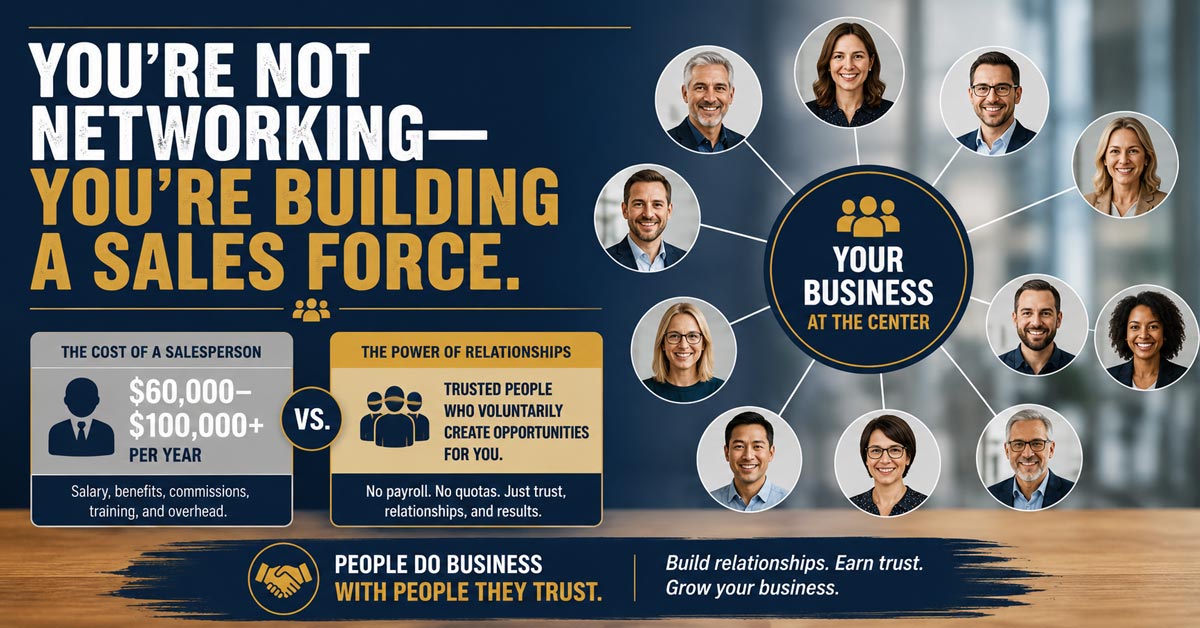
When people hear the word networking, they often picture weekly meetings, stacks of business cards, and pressure to bring referrals. For many small business owners, that’s enough to make them walk away. They think, I don’t have time. I’m already overwhelmed. I don’t know enough people to generate referrals. I don’t want another obligation. Those concerns are understandable, especially if you’ve experienced networking groups where success is measured by how many referrals you hand out each month or how many mandatory one-on-one meetings you complete.
But what if networking wasn’t really about networking at all? What if you were actually building a sales force?
The Sales Team Most Small Businesses Never Build
Large companies invest heavily in sales teams. They hire people whose full-time job is introducing the company to prospective customers, building relationships, and earning trust. Most small businesses don’t have that luxury. The owner answers the phone, delivers the work, handles marketing, manages the books, and somehow tries to find time to bring in new customers. When business slows down, there isn’t a dedicated sales department to fill the pipeline. Everything depends on the business owner finding time they simply don’t have.
That’s why building relationships matters. Every trusted relationship you create becomes another person who understands what you do, who you help, and when someone might benefit from your services. Over time, those relationships begin working for you—even while you’re busy serving your existing customers.
Referrals Don’t Come From Strangers
One of the biggest misconceptions about networking is that referrals come from people you barely know. In reality, referrals come from people who trust you. That trust develops through conversations, shared experiences, and taking the time to understand someone’s character as much as their profession.
When someone confidently says, “You should call Sarah,” or “I know a great electrician,” they’re putting their own reputation on the line. People don’t make those recommendations simply because they attended the same meeting. They make them because they’re confident the experience will reflect positively on them. Trust is the currency behind every referral.
Why One-on-One Meetings Matter
Many networking organizations encourage or require members to meet one-on-one outside of regular meetings. To some business owners, that sounds like another item on an already overwhelming to-do list. Viewed from another perspective, however, those conversations are where the real value of networking begins.
A one-on-one meeting isn’t about exchanging leads or asking for business. It’s about learning someone’s story. You discover what motivates them, who their ideal customer is, what problems they solve, and what makes them different from everyone else in their industry. As your understanding grows, so does your ability to recognize opportunities where you can confidently introduce them to someone who needs their services.
Just as importantly, every new relationship expands your own network. The person sitting across from you already knows dozens—perhaps hundreds—of people you don’t. One trusted relationship often becomes the bridge to many more.
Building Your Personal Sales Force
Imagine having twenty people who genuinely understand your business. Now imagine fifty, or even one hundred. They’re not employees, and they’re certainly not commissioned salespeople. They’re trusted professionals who have come to know your character, understand your expertise, and naturally think of you when conversations arise.
That is the sales force most small businesses never intentionally build.
Every relationship adds another person who can tell your story when you’re not in the room. Every conversation increases the number of people who recognize the problems you solve. No advertising campaign can replace that kind of credibility because referrals carry something advertising never can: personal trust.
The Elite Business Connections Difference
At Elite Business Connections, we don’t measure success by referral quotas or keep score based on how many leads members hand one another each month. Instead, we focus on helping members build authentic professional relationships because that’s where lasting business growth begins.
Some referrals happen quickly. Others may take months or even years. Sometimes a referral comes from someone you’ve never met because a trusted connection introduced your business to another trusted connection. That’s how real business communities grow. The goal isn’t to manufacture referrals—it is to become known, understood, and trusted. Business naturally follows trust.
Participation Creates Opportunity
The greatest benefit of participating in Elite Business Connections isn’t simply attending meetings. It’s becoming part of an expanding community of professionals who know who you are and understand the value you bring. Every meeting introduces someone new, every conversation deepens an existing relationship, and every one-on-one discussion broadens your circle of influence.
Not every interaction produces business this week, nor should you expect it to. Relationships take time to develop, just as trust takes time to earn. Yet every meaningful conversation increases the likelihood that someone will remember you when the right opportunity appears. Over months and years, those opportunities begin to compound into something far more valuable than a handful of referrals—they become a network of advocates who are genuinely invested in your success.
Stop Thinking About Networking
The next time someone invites you to a networking event, don’t think about business cards, referral quotas, or obligations. Think about building your sales force.
Except this sales force isn’t motivated by commissions or contracts. It’s powered by relationships, strengthened through trust, and expanded one conversation at a time. When enough people know you, understand your business, and believe in the quality of your work, they become advocates who open doors you could never reach alone.
That’s why you’re not really networking.
You’re building a sales force, and it’s one of the smartest investments a small business owner can make.

Ed Bejarana
Ed Bejarana is the founder of Main Street WebWorks, where he helps small businesses improve their digital visibility so people, search engines, and AI assistants can find, understand, and confidently recommend them. With more than three decades of experience in technology and digital marketing, Ed has designed over 2,500 websites and developed practical frameworks—including EASE™, E-E-A-T, and ATLAS™—that help businesses build authority, strengthen AI signals, and create meaningful connections with customers. As a veteran, author, and educator, he enjoys translating complex technology into practical strategies that help local businesses thrive in an AI-driven world.