
How Strategic Recruiting for EBC Can Grow Your Own Business
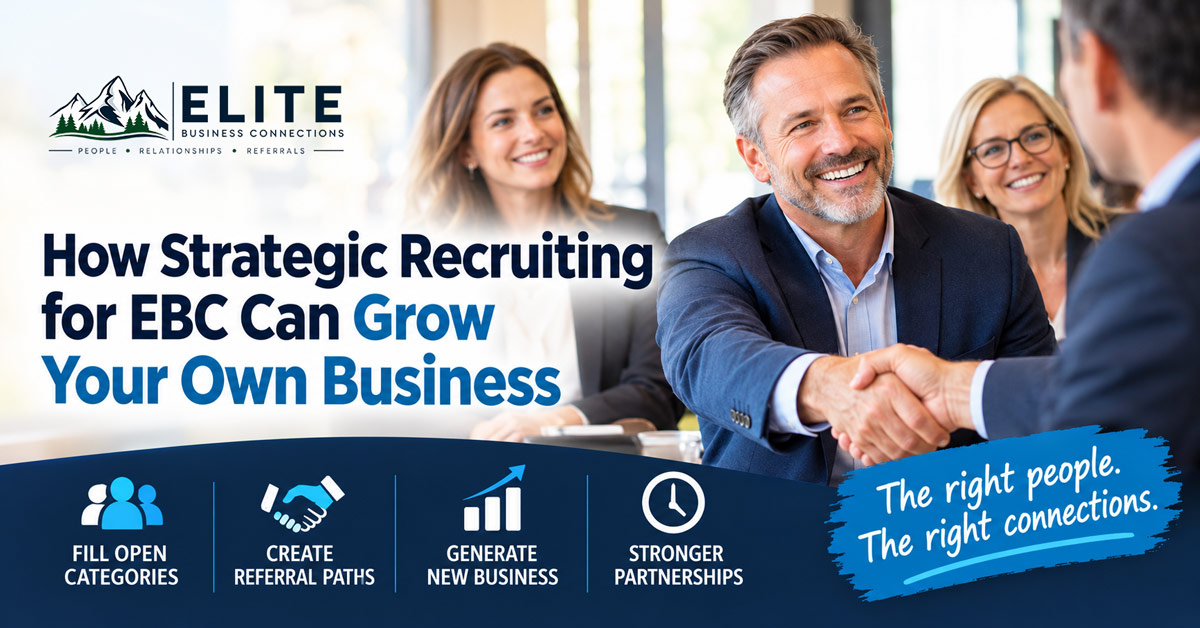
Most members think of inviting a guest as a way to help the group. Under the new membership system, it can also be a direct way to grow your own business.
The cap of 30 and the exclusive categories are designed so every seat creates real referral paths instead of competition. That means the people you help bring in can start generating business for you—sometimes within weeks of joining. The key is to stop inviting whoever is available and start targeting the open categories that specifically benefit your work.
Two kinds of prospects worth pursuing
There are two practical reasons to go after a particular open category:
- Someone you would personally use.
You already know (or can quickly confirm) that you would trust them with your own home, business, or customers. When you later refer them, you are not guessing. You are recommending someone you have already vetted. That is the “hero factor.” The new member sees you as the person who brought them trusted business early. Trust forms faster. Reciprocity usually follows. - Someone whose customers naturally need what you do.
Their everyday work creates situations that lead to your service. You are not asking them to invent referrals. You are positioning yourself next to a business that already talks to the right people.
Both types are stronger than a random invitation. Both are also easier to explain when you reach out.
Concrete examples
A Realtor (currently open) is a natural lead generator for a short-term rental business. Buyers and sellers frequently ask about property management, cleaning, or furnishing a home they will not live in full-time. The Realtor who already knows and trusts the short-term rental member can make that introduction cleanly. The short-term rental member gains a steady source of owners; the Realtor gains a reliable specialist they can recommend without hesitation.
A property manager or multi-family operator is a strong fit for a landscaping or exterior maintenance company. Property managers regularly need lawn care, seasonal cleanup, irrigation, and curb-appeal work across multiple properties. When the landscaper is the only one in the room, the property manager does not have to choose. The referral is simple and recurring.
Other pairings work the same way:
- An electrician or plumber can become a steady source of remodeling and handyman work (and vice versa) when something they open up needs finishing.
- A home inspector or Realtor can generate consistent opportunities for a home inspector’s complementary trades (HVAC, roofing, pest, foundation) once those seats are filled.
- A CPA or tax professional often hears about business owners who need insurance, legal, or website help long before those owners go looking.
Look at your own ideal customer. Then look at which open categories talk to that customer every week. Those are the people worth contacting.
How to approach them (including cold outreach)
You do not need a warm introduction to start the conversation. A short, specific outreach works better than a generic “join my networking group” pitch.
A useful approach:
- Identify the open category that helps you most. Check the current member directory so you know the seat is still available.
- Find two or three local businesses in that category that already have a solid reputation.
- Reach out by phone, email, or a brief in-person visit. Lead with the mutual benefit, not the meeting time.
Example framing:
“I’m part of a small referral group in Coeur d’Alene that protects one seat per category. We currently have an open seat for [their category]. I’m reaching out because my clients regularly need what you do, and I would rather send that work to one trusted person than keep looking. Would you be open to visiting one Tuesday morning so you can see whether the group is a fit?”
Or, if you would personally use them:
“I’ve been looking for a reliable [their service] for my own [home/business/clients]. Before I start referring people to someone new, I wanted to see if you would be interested in a group where members actually know each other’s work. We have the [category] seat open.”
The visit-first rule helps here. You are not asking them to join. You are inviting them to see the room. Most people will take a low-pressure look at a Tuesday meeting if the reason you contacted them is clear.
What happens after they visit
Once someone attends, the rest of the process stays the same for everyone:
- They submit an application that names the open category and describes the work.
- Leadership reviews the category against seats already protected.
- The group hears a short presentation and votes (two-thirds of those voting).
- If approved, they complete dues and onboarding, then the category is protected and they appear in the directory.
Your job as the inviting member is not to guarantee the outcome. It is to bring someone the group can actually recommend and to be ready to answer questions about why you think they fit. Members who have already used the person (or who regularly refer that type of work) usually make the strongest case.
Why this is worth your time
Every open seat you help fill with a complementary business shortens the distance between “I know someone” and “here is a qualified introduction.” The 30-member cap means those seats will not stay open forever. The businesses you contact now are more likely to become long-term referral partners than the ones who join later through someone else.
Start with one or two categories that clearly help your business. Make the outreach specific. Invite them to visit. Then let the process and the room do the rest.
Meetings remain Tuesdays, 7:15–8:30 a.m., at the NIBCA Conference Room, 1928 N Fourth Street. If you want help identifying which open categories currently create the most referral paths for your type of work, bring it up at the next meeting or talk with leadership.

Ed Bejarana
Ed Bejarana is the founder of Main Street WebWorks, where he helps small businesses improve their digital visibility so people, search engines, and AI assistants can find, understand, and confidently recommend them. With more than three decades of experience in technology and digital marketing, Ed has designed over 2,500 websites and developed practical frameworks—including EASE™, E-E-A-T, and ATLAS™—that help businesses build authority, strengthen AI signals, and create meaningful connections with customers. As a veteran, author, and educator, he enjoys translating complex technology into practical strategies that help local businesses thrive in an AI-driven world.